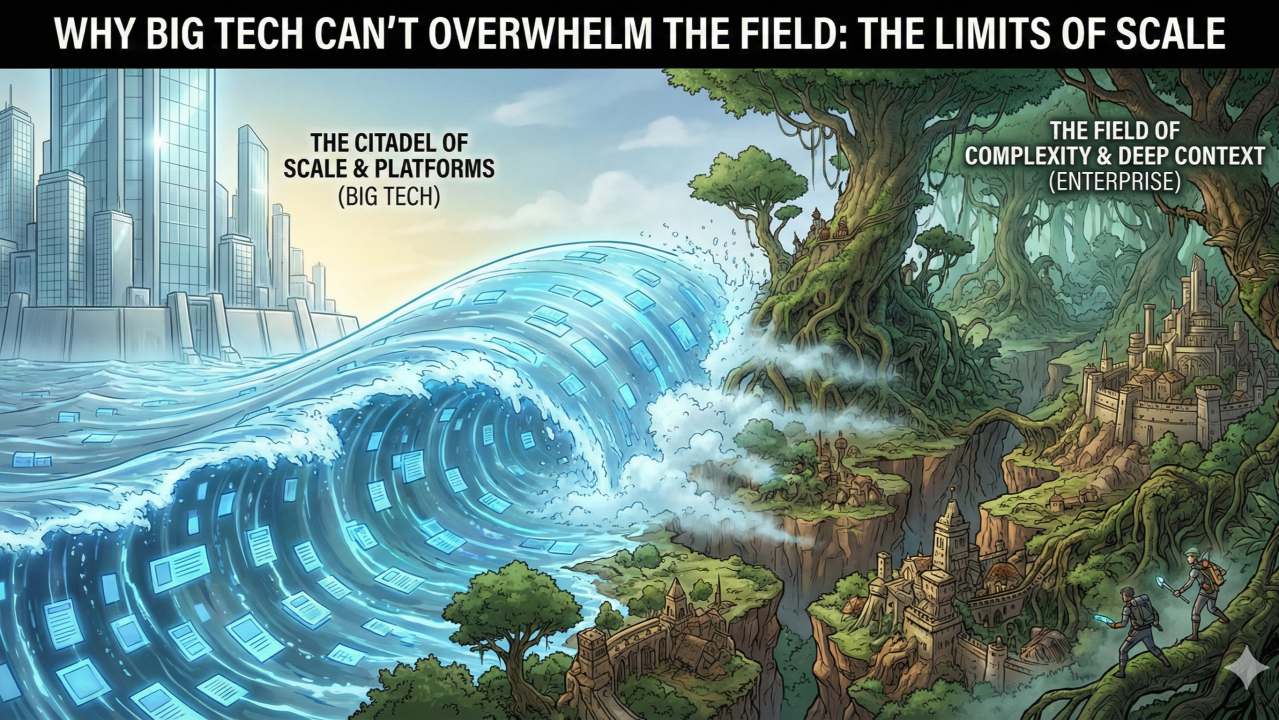
There is a structural flaw in how Big Tech innovates, and it is the single greatest advantage for Enterprise Startups today.
During my time in Big Tech, I saw the same pattern play out repeatedly. Every VP is measured by one metric: Scale of Impact. To get promoted, to get headcount, or to simply survive a re-org, a project needs to promise 100M users or $1B in revenue fast.

This creates a "Death Valley" for innovation. Any problem that requires "outsized dedication but limited initial impact" will never get funded. Or worse, it gets funded by a visionary Sponsor, but the moment that Sponsor rotates to a new division (or leaves), the project is folded.
We saw this with initiatives like Google Express. In Big Tech, innovation is often tied to a person, not a business case. When the person leaves, the innovation dies.
The Trap of Consumer AI
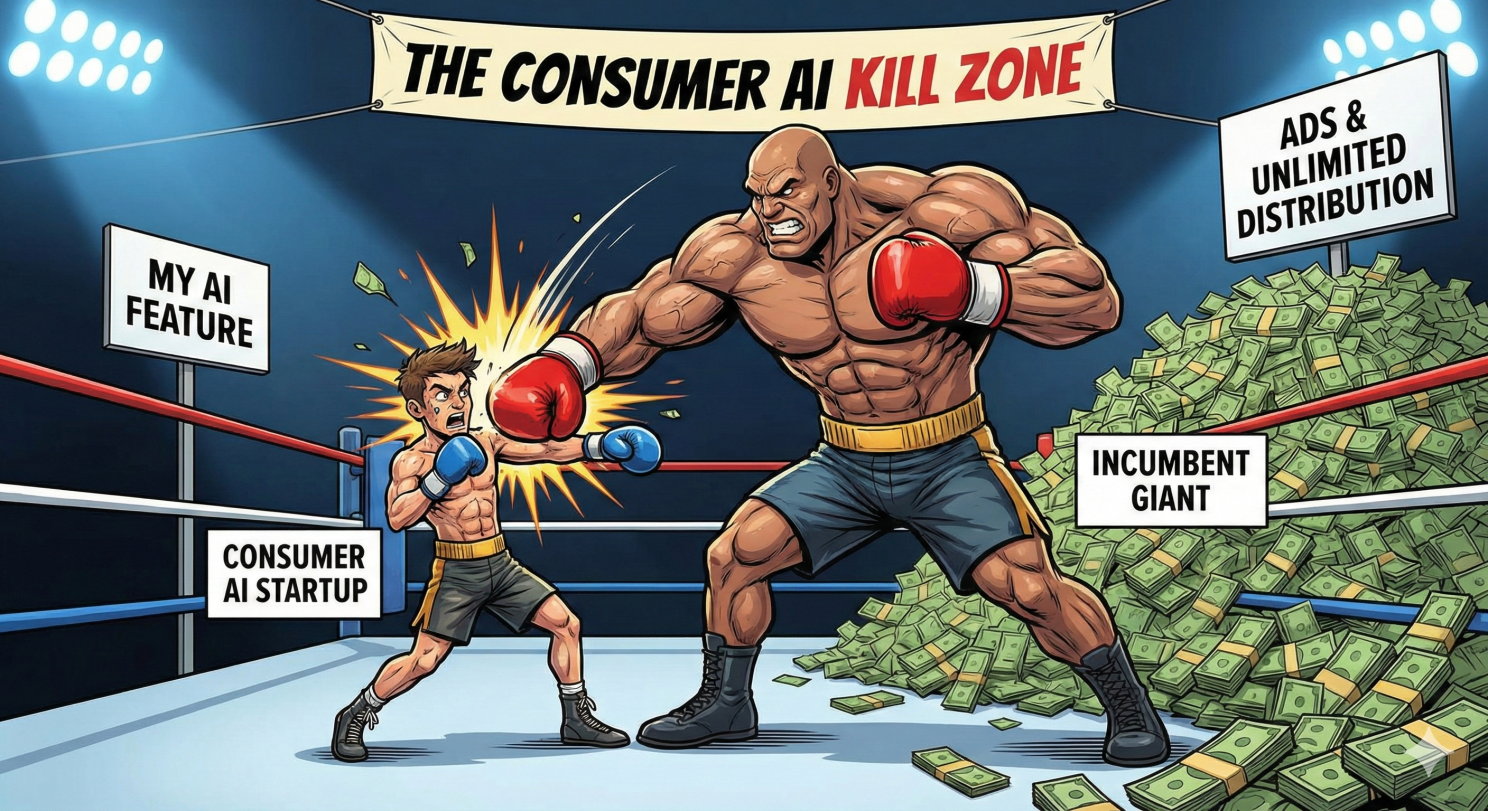
For startups, this dynamic makes the Consumer/Prosumer space a kill zone. In Consumer, AI is rapidly becoming just a feature of incumbent products.
- Notion adds AI.
- Apple integrates Intelligence.
- Google/Meta can subsidize the cost with Ads.
If your competitor has infinite distribution and can price their product at $0 (because they sell Ads), you are not going to win. You are fighting gravity.
The Sanctuary: The Enterprise Moat
This is why Enterprise is the winning angle for Startups in this wave.
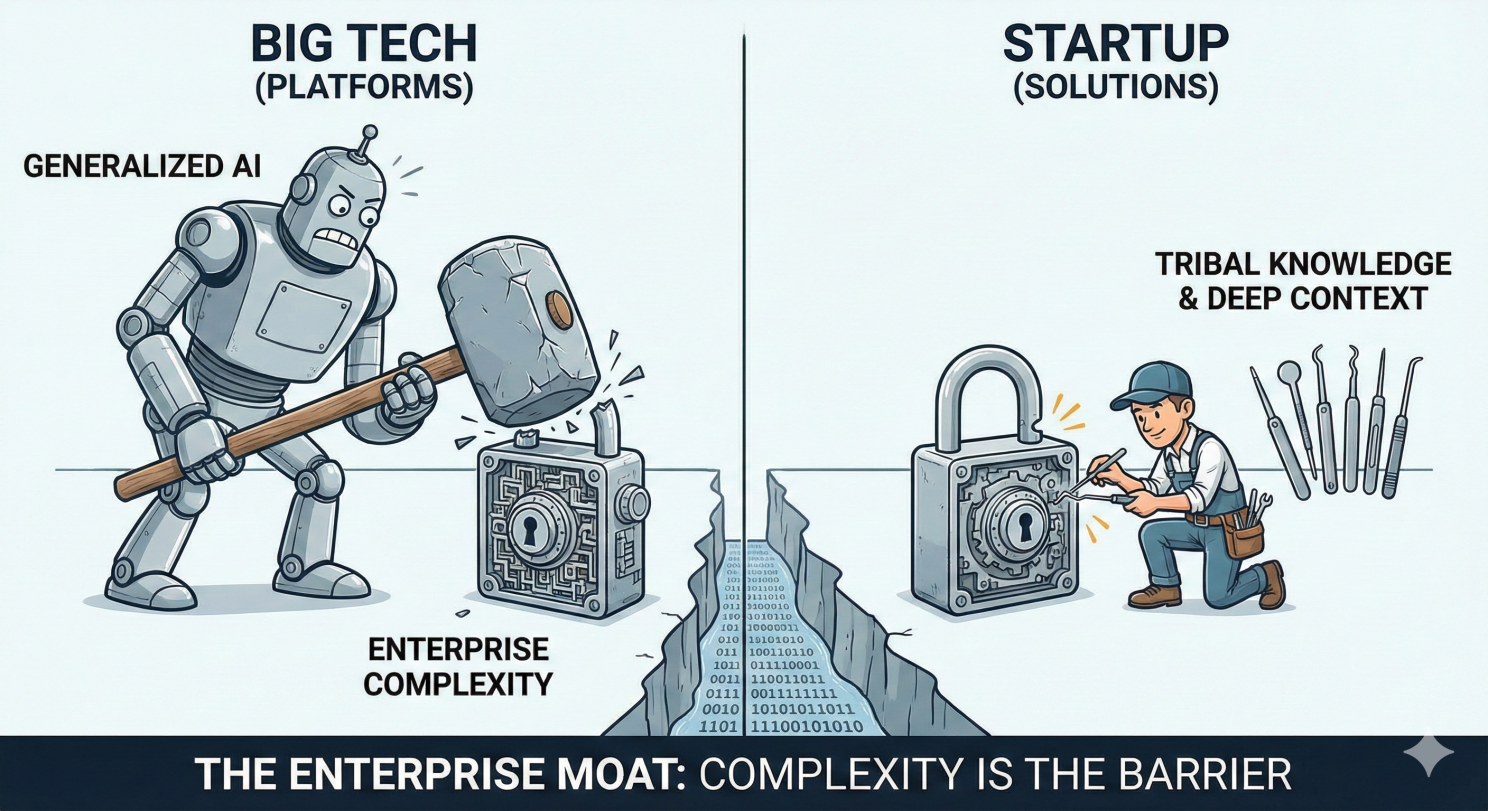
The Enterprise is messy. It is full of "boring," highly specific problems that require deep tribal knowledge to solve.
- A Google VP cannot justify spending 18 months optimizing a regulatory workflow for a specific manufacturing vertical. The TAM looks too small on a slide deck.
- But for a Startup, that specific workflow is a beachhead.
Big Tech builds Platforms (horizontal, general, scalable). Startups build Solutions (vertical, specific, deep).
In the Enterprise, the barrier to entry isn't compute; it's Context. No consumer giant has the will, the patience, or the incentive structure to crack the door of deep enterprise complexity. They physically can't do it without breaking their own promotion metrics.
That is your moat. Dig it deep.