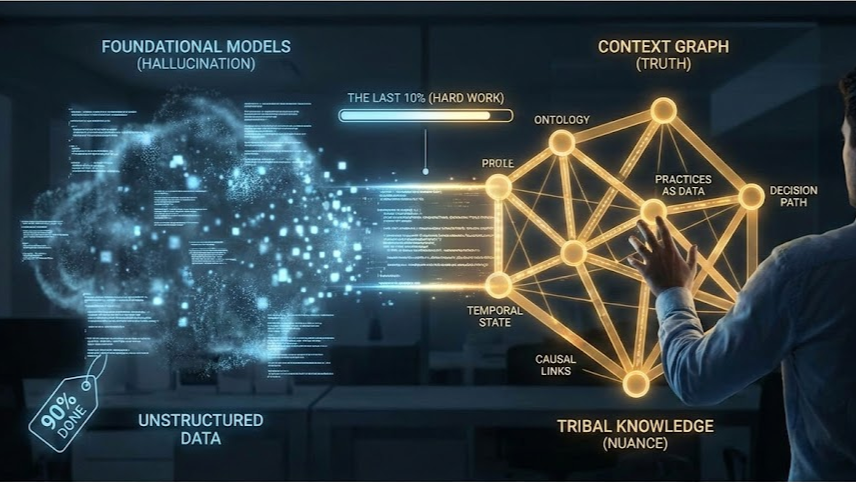
We are entering the "trough of disillusionment" with Enterprise AI. The easy demos are over. The wrapper startups are churning. And we are all waking up to the same hard truth:
You cannot prompt-engineer your way out of a data deficit.
The current generation of Foundational Models are incredible at reasoning, but they are amnesiacs. They have no memory of why your organization works the way it does. They hallucinate because they are forced to guess across gaps in your data that you haven't bothered to bridge.
The "Trillion-Dollar" Gap: Nouns vs. Verbs
There is a defining thesis circulating right now from Jaya Gupta and Ashu Garg at Foundational Capital : "Context Graphs are AI's Next Trillion-Dollar Opportunity."
We have spent twenty years building "Systems of Record" for Nouns (Salesforce for customers, Workday for employees). But we have zero "Systems of Record" for Verbs (Decisions, Trade-offs, Exceptions).
- Why did we override the safety protocol on Project X?
- Why did we discount this contract despite the policy?
- Why is this "outdated" document still the source of truth?
This Tribal Knowledge is the "Last 10%" of the data problem. And in deep tech, the last 10% requires 90% of the effort.
The "Last 10%" Problem
During my years at Google X, I learned a painful truth about deep tech: The first 90% of a project (the demo) takes 10% of the effort. The last 10%—the gap between "plausible" and "mission-critical"—takes the other 90%.
We are seeing this play out in Enterprise AI right now. Foundational Models are hitting a wall. We have to be honest: Hallucination is a feature, not a bug. These models are designed to dream, not to recall.
To bridge that final 10% reliability gap, we don't need more compute. We need constraints. We need the "hard work" that most wrappers are trying to avoid.
The "Google vs. Bing" Problem
Why does Google Search have 90% market share while Bing has 4%? It’s not because Bing can’t find the weather or the stock price. For 90% of queries—the "head" queries—Bing is excellent. Google won because of the Last 10%.
Google won because when you ask a messy, nuanced, "long-tail" question, it understands the intent behind the keywords. It bridges the gap between what you said and what you meant.
In the race for Enterprise AGI, this history is repeating itself.
Right now, most "AI" startups are building the "Bing" of enterprise data. They use off-the-shelf RAG to index your PDFs. They get the easy 80%. They can tell you "What is our vacation policy?" But they fail at the Last 10%—the mission-critical nuance:
- Why did we override the safety protocol on Project X?
- Why is this "approved" document actually invalid in this specific region?
That Last 10% is where the trust is earned. And you don’t get there with a wrapper. You get there with Hard Work.
Why Segmental is taking the Hard Road
At Segmental, we are executing on the Context Graph thesis, but we are doing it by tackling the unglamorous data engineering that others ignore.
A Context Graph isn't just drawing lines between documents. It requires building expressive Ontologies that capture the nuance of human work:
- The Temporal Nuance: Knowing that a policy document from 2021 is "outdated" but still "historically relevant" for a lawsuit today.
- The Authority Nuance: Knowing that a Slack message from the CTO outweighs a Jira ticket from an intern.
- The Causal Nuance: Understanding that Decision B happened because of Constraint A.
Capturing this is not a magical AI process. It is hard, structural data work. It requires treating "practices as data."
We are building Segmental for the enterprises that know the difference between a demo that looks cool and a system that actually knows.
The Trillion-Dollar opportunity is real. But it won't be won by those with the biggest models. It will be won by those willing to do the hard work of structuring the truth.
The Thesis & The Solution:
- The Vision: Read Jaya Gupta's breakdown on why Context is the missing layer: “Context Graphs: AI’s Trillion-Dollar Opportunity”
- The Execution: How Segmental is engineering the ontology for the enterprise.